Vasily Denisov
War and PeaceVasily Denisov is a Pavlograd Hussar commander known throughout the cavalry division as Vaska Denisov, a figure whose comic speech and explosive energy conceal an exceptionally serious capacity for loyalty. He is at once a practical soldier, an aggressive field leader, and a deeply attached friend: his behavior toward Nicholas Rostov, his endurance of military deprivation, and his reaction to Petya Rostov’s death reveal the human cost of war more powerfully than any formal declaration of heroism.
Identity and Military Setting
Denisov commands the squadron in which cadet Nicholas Rostov serves. In October 1805, the squadron is quartered in the German village of Salzeneck, two miles from Braunau, while the Russian army occupies Austrian villages and towns under the command of Mikhail Kutuzov. Rostov has lived with Denisov since overtaking the regiment in Poland, so the commander is introduced not merely as a superior officer but as the young cavalryman’s daily host and military companion.
The first description of Denisov is deliberately physical and comic. He has the nickname Vaska Denisov, and his speech is rendered with a strongly marked pronunciation. Yet the apparent caricature is attached to a capable officer. When the Russian army retreats along the Danube, Denisov remains within the dangerous practical world of rearguard action, where cavalry must respond quickly to enemy fire, confused orders, and the need to preserve the army’s heavy equipment rather than pursue theatrical victories.
Courage, Command, and the Danube Campaign
During the crossing and defense of the bridge, Denisov reacts to the first experience of enemy fire with a mixture of mockery and professional recognition. After Nicholas Rostov has been exposed to grapeshot, Denisov calls out that he has “smelt powdah” and praises him for working like regular bricks. His rough encouragement does not deny the danger. Instead, he distinguishes between the excitement of attacking and the far more unnerving experience of being exposed as a target while artillery fires at the line.
That distinction is important to Denisov’s military character. He understands that battlefield courage is not a single, stable quality. The cavalryman who can charge an enemy may still be shaken when the enemy cannot be seen and the body must simply wait for impact. Denisov’s humor gives the frightened Rostov a language in which fear can be acknowledged without humiliation. The regiment’s camaraderie therefore becomes a form of discipline alongside the formal order of commanders and the movements of squadrons.
Denisov belongs to a Russian force retreating under severe material pressure. The army of Mikhail Kutuzov is pursued by a French army of one hundred thousand under Napoleon Bonaparte, while the Russians, numbering only thirty-five thousand, suffer from hostile local populations, unreliable allies, and shortages. The actions at Lambach, Amstetten, and Melk slow the French only enough to preserve the retreat. Denisov’s world is consequently shaped less by splendid victory than by endurance, improvised defense, and the preservation of men and equipment under impossible conditions.
Hardship and Partisan Action
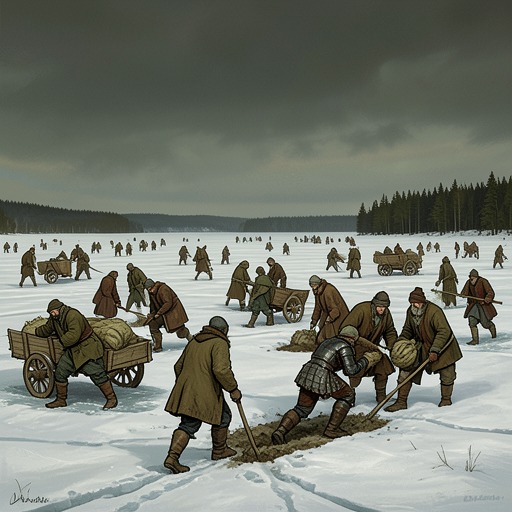
The later campaigns make Denisov’s leadership inseparable from logistics. The Pavlograd Hussar Regiment has exchanged shots with the enemy, taken prisoners, and even captured Marshal Oudinot’s carriages, but its more destructive enemy is deprivation. Near a ruined German village, thaw and rain turn the roads impassable; no provisions or fodder arrive; soldiers search deserted villages for potatoes; and nearly half the regiment dies from hunger and sickness even though only two men are wounded in action. Such conditions expose the limits of military heroism: courage cannot replace food, transport, sound roads, or medical care.
Denisov nevertheless continues to organize resistance. During the partisan operations, he considers a second attack too dangerous because it might alert the entire French column. Rather than convert a limited opportunity into reckless combat, he sends Tikhon Shcherbaty to Shamshevo to seize at least one French quartermaster sent ahead. His method combines audacity with restraint. The objective is concrete and useful—capturing a man connected with the enemy’s supply arrangements—rather than pursuing glory through an unnecessary assault.
The narrative presents Denisov in weather that strips away military ornament. On a warm, rainy autumn day, rain runs from his felt cloak and sheepskin cap; his horse is thin and hollow-sided; and his face, framed by a short, thick black beard, looks angry and anxious. Beside him, Esaul Lovayski the Third appears completely at ease on a large Don horse, while Denisov seems merely a wet man mounted on a horse. The contrast makes Denisov’s discomfort visible without diminishing his authority. He is not mythically above hardship; he is a commander physically absorbed by it and still required to act.
Friendship and Emotional Attachments
Denisov’s relationship with Nicholas Rostov is one of his defining bonds. Rostov lives with him, rides under his command, and receives from him an informal mixture of teasing, praise, and protection. When Rostov is frightened at the bridge, Denisov does not subject him to an abstract lecture about courage. He recognizes the experience immediately and speaks in the language of the regiment. Their friendship is therefore created through shared danger and ordinary military intimacy rather than through sentimental confession.
Denisov also participates in the wider emotional world of the Rostov household. After the duel involving Pierre Bezukhov and Fyodor Dolokhov, Denisov returns to Moscow early in the winter of 1806 and stays with the Rostov family. The first half of that winter is remembered as one of the happiest periods for Nicholas Rostov and his family, and Denisov belongs to the circle of young men who fill the house with sociability, music, and romantic expectation. His presence links the military world to the domestic world, though the later campaigns show how fragile that connection is.
His response to death reveals the depth beneath his rough exterior. At the engagement in which Dolokhov and Denisov rescue Russian prisoners, Petya Rostov is killed by a bullet through the skull. Denisov recognizes from a distance the lifeless attitude of the body, a sight already familiar to him. After dismounting, he turns Petya’s bloodstained, mud-bespattered face toward himself with trembling hands and recalls Petya’s recent words about wanting something sweet, especially raisins. He then turns away with a sound compared to a dog’s yelp and grips a wattle fence. The veteran commander’s grief is not eloquent or controlled; it breaks through the discipline of the soldier’s body.
Change, Grief, and Narrative Significance
Denisov’s arc does not consist of a conventional promotion from weakness to strength. He is already energetic and brave when first introduced. What changes is the scale at which his courage is tested. At the bridge, he helps Nicholas Rostov survive the shame and terror of first exposure to fire. In the later campaigns, he must lead men through hunger, sickness, mud, and failing transport. In partisan warfare, he must judge when not to attack. Finally, after Petya’s death, command offers no protection from personal devastation.
The contrast between Denisov’s outward manner and inner attachments is central to his significance. His comic accent, rough jokes, and aggressive preference for attack can make him seem like a military type, but his conduct repeatedly complicates that impression. He recognizes fear in others, values comradeship, acts cautiously when the tactical situation demands it, and grieves over a young friend with an intimacy that leaves him physically shaken. The same war that produces tales of captured carriages and daring raids also produces starving regiments, abandoned hospitals, exhausted horses, and bodies carried to improvised graves.
When Denisov walks behind Cossacks carrying Petya’s body to a hole dug in a garden, his military identity is reduced to the simplest human fact: he is accompanying the dead. The episode completes his portrait by bringing battlefield action and private feeling into the same frame. Denisov’s importance lies not in presenting war as a sequence of heroic exploits, but in showing how courage, comradeship, logistical suffering, and grief remain inseparable within the life of a regiment.